Why preventing no-shows pays off for your revenue
No-shows affect any organisation that relies on scheduled appointments. Reducing them can protect revenue, make better use of staff and facilities, and improve access to care. This article explains the financial case for taking action.
- What are no-shows?
- Downsides of no-shows
- Impact of no-shows on the organisation
- Popular measures to prevent no-shows
- Successfully preventing no-shows with AI
- Benefits of prediction and phone reminders
- Conclusion
What are no-shows?
A no-show occurs when a patient misses an appointment without cancelling in advance. The appointment time and associated staff capacity go unused, while the organisation’s costs remain. Teams may also need to spend additional time contacting patients and arranging new appointments.
Downsides of no-shows
No-shows can affect an organisation in several ways:
- Higher workload: Staff have to put in extra effort to reschedule appointments, which increases the workload for both administrative and clinical staff.
- Lost revenue: Every no-show means missed income, while costs keep running.
- Fewer clients can be helped: No-shows mean fewer clients can be helped, which is a real waste at a time of waiting lists.
Impact of no-shows on the organisation
Many healthcare costs are fixed in the short term: premises, staff and equipment must be available whether or not a patient attends. When an appointment is missed, the organisation may receive no income for that time, while those costs remain.
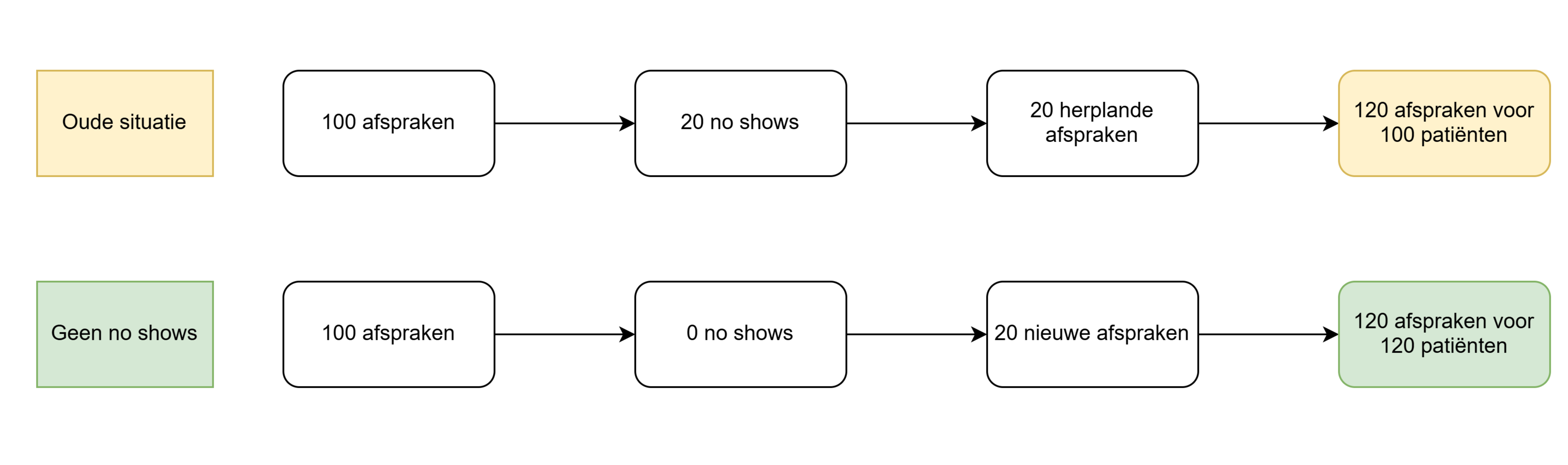
An example: suppose you have scheduled 100 appointments for 100 clients. Of those 100 clients, 20 don't turn up, which means you have to schedule new appointments for those 20 clients. As a result you end up needing 120 appointments to help the same 100 clients. If you prevent those 20 no-shows, you can help 120 different clients with 120 appointments.
Preventing no-shows increases revenue. Without no-shows, every appointment generates revenue. Because you are dealing with fixed costs, your profit goes up.
I show this schematically in the image below.
Popular measures to prevent no-shows
Many organisations use reminders to reduce missed appointments. SMS messages are quick and convenient, but they do not reach everyone in time, and some patients may overlook them. Reminders can help, but they may not address every reason an appointment is missed.
Another option is sending an email reminder. This is attractive because it costs little and is easy to send at scale, but the downside is that emails sometimes go unopened or end up in the spam folder.
Phone reminders are also a popular choice. The advantage is that they are more personal and harder to ignore, which makes them effective at preventing no-shows. They even work well if you already send an SMS or email reminder. But they take a lot of time and staff, which often makes them unprofitable.
Some organisations overbook appointments to compensate for expected no-shows. This can reduce unused capacity, but it also risks overcrowding and longer waits when everyone attends, with a negative effect on the patient experience.
Successfully preventing no-shows with AI
Calling patients can be an effective reminder, but calling everyone requires significant staff time and may not be cost-effective. Predicting which appointments are most at risk can help teams target those calls.
With AI this can be done far more efficiently, so the effort stays limited while the increase in revenue is large.
Let's work through an example revenue calculation. Suppose there are 100,000 appointments a year, of which 10% are no-shows. That means there are 10,000 no-shows. With an AI model we predict which appointments are at risk of a no-show, so only those clients get a phone reminder.
Previously you would have had to call about all 100,000 appointments. A big effort to reach 10,000 no-shows: 90% of the calls are made for nothing. With noshowsvoorspellen.nl this is much more efficient.
This lets us prevent no-shows, even if you already send an SMS or email reminder. At €50 revenue per appointment, this means expected extra revenue of around €100,000 a year. At €100 revenue per appointment, that is €200,000 in extra revenue a year.
So for 35% of the effort you get comparable revenue. More than a good deal.
Benefits of prediction and phone reminders
Using an AI model to predict no-shows, combined with targeted phone reminders, offers several benefits:
Positive effects for clients
- More care delivered: Fewer no-shows means more clients can be helped. In the example above you can help 800–2,000 more clients.
- Better patient experience: Clients appreciate the phone reminder as an extra service, and it improves the overall patient experience.
- Inclusive care: Patients who find care harder to access, for example because of language or digital barriers, are helped more often thanks to phone reminders.
- Better contact details: Regular contact means outdated or incorrect contact details can be updated.
Positive effects for staff
- Less rescheduling: Fewer no-shows means staff spend less time rescheduling appointments.
- Better spread of workload: With fewer no-shows, the workload is better balanced.
Financial
- Profitable: The cost of reminders goes down, and revenue rises significantly as no-shows decrease.
Conclusion
Reducing no-shows can improve both the financial and operational performance of appointment-based services. Missed appointments leave capacity unused, while rescheduling adds to staff workload and can delay access to care. Data-driven predictions can help organisations identify higher-risk appointments and focus reminders where follow-up is most likely to help. The result can be better use of available capacity and a more reliable experience for patients.